Thursday, February 20, 2014

3.1.5 Variable Functions

In this packet, we were introduced into the plus block function, variable function block, and branch function block. 

Timeserver the program passes through the Plus function block, it adds a value to the block on the right block. And the variable function block keeps track of the value. 

The Branch Function Block is similar to the analog function block, except the branch retrieves information from whatever value is provided through the information node. In this case, the variable function block.

We used what we learned to turn on a lamp for a certain amount of time. 

Here is the lamp, and how it responds to the program. 

Wednesday, February 19, 2014

Super Advertising: 2014 Volkswagen Game Day Commercial: Wings


With the Super Bowl coming this past weekend, many companies spent big bucks securing their spots for slots on the air. For 30 seconds of air-time, a company must pay $4 million. The commercial that we chose, the "Volkswagen Wing Commercial", Volkswagen had to drop $8 million for it's minute long airing. With this, Volkswagen would have to sell 178 of it's most expensive 2014 model. (2014 Touareg coming in at $45,000) in order to make up that money. Above is the video to the commercial.

3.1.3 Basic Programming

In this worksheet, we learned to program a motor to run for a set amount of time. We were introduced to the basic program elements like Start, M1 output, Timd Delay, and End Program.

This is our flowchart, with text to show what each block does.

3.1.4 Branch Functions

As a gropu, we learned the difference between digital and analog functions. Digital is when the action is to turn off/off and analog is when there is a scale of a different values applied. We also learned that branch functions offer the program to make a decision because every branch function is a yes/no question. Programming two switches to have different jobs under the same function was something else we learned. With help from Mr. Olsen, we were able to learn how to use the potentiometer, which led us to be able to dim a light, because the potentiometer behaves as an analog device. It's important because there can be different outcomes for the same input.

This is our branch function with multiple decisions based on the value of the potentiometer, which let us dim the light.


This is our potentiometer.

Wednesday, February 12, 2014

3.1.1 Inputs and Outputs


In this activity, our group learned about digital inputs and analog inputs. We also learned about outputs, and how they can be used to control a buzzer and motor, by using the fischertechnik ROBO TX Controller.


 Digital Inputs
Switch normally open, no voltage present


Press switch, voltage now present. Represented by 1.


Mini Switch normally closed. Voltage present without pressing switch.
Press the switch, no more voltage present 


Analog Inputs
Using the Potentiometer to resemble analog inputs

Outputs

Motor output spinning


Test Interface allows us to control the inputs and outputs. In this case, the motor output.


Thursday, December 19, 2013

Manila Folder Bridge Build


These 2 pictures are from our final result from the 2 manila folder poles. The total is 57 magazines.
21 magazines, and then 36 from the other.

More Pictures


Monday, December 16, 2013

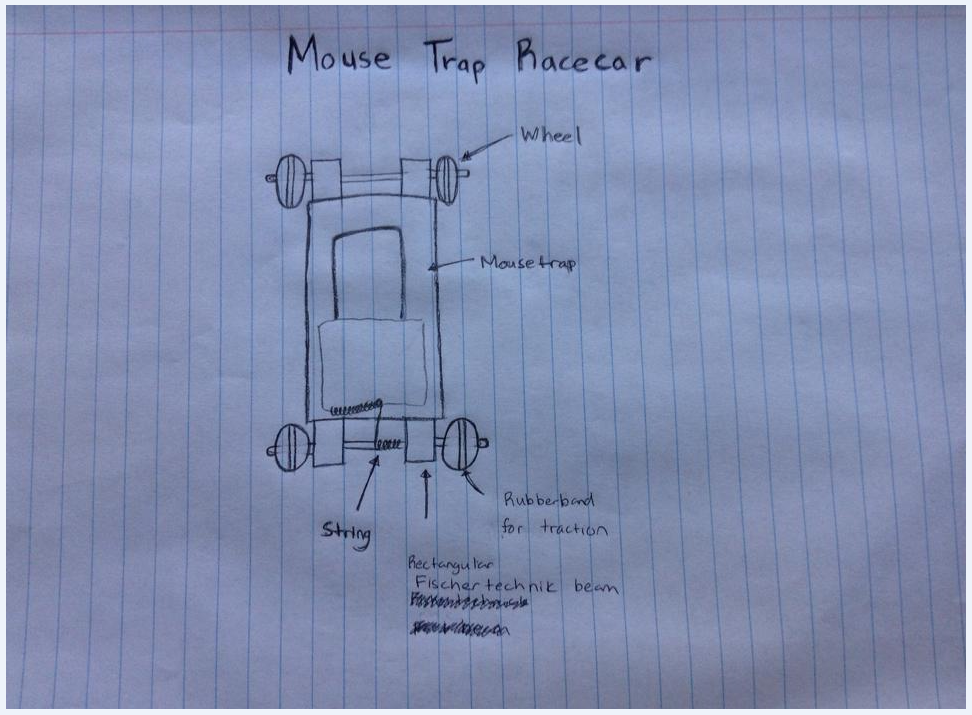
Mouse Trap Race Car

Team members: Chris Ruiz, Max LeBaron, Owen Heidenreich

We are claiming 7 achievements


Design stage:

Visualize It! 
Create a sketch of a design and label key features.


Build stage: 

Build It
build your design, document it with a photo


Test Compete stage:
"Competitor -  Compete in the mouse trap racecar challenge
We competed in second annual mouse trap racecar and we placed in last place

Feedback  Collect feedback (at least one each of +, change, ? and !) from yourself or your classmates.
Change: Max says We should have asked more questions about how to build it
!: owen built the race car by himself
?: a lingering question we have is "How does the string accelerate the mousetrap?"
+: Positive, we were all genuinely interested in this challenge.

Iterate stage :

Game Changer Develop a new rule or change to the game that you feel would make the event better. Explain your concept.
"No sticks":There should be no sticks to attach to the mouse trapper to create more leverage with the accelerator. This means that instead of the mouse trap clapper being its usual length of about 4 inches, people were attaching a long pole to the mouse trap and then putting their string at the end of that pole so that the mouse trap would act as if it were far greater than four inches, which would then create an advantage as the car would travel faster and further.

Name it - Invent a name for an achievement that you think is better than what we have currently.
The achievement that is named "The Price of Glory" should be named "Graft" because in politics a graft is the unscrupulous use of a politician's authority for personal gain ie. bribing people for votes.
 The person is buying things that give them an advantage in the race, therefore they are a Graft. This name will also provoke questions related to this word which will hopefully encourage them to learn more.

Reflection stage:

Build/Design 
What is a "Design/Build" process? How did your experience with this challenge relate to that? Why might you experience this in a career related to technical innovation?

A design/build process is more than just a physical design and build but it is also a test of perseverance and social orginization skills. It is also a test of motivation and willingness to work hard to achieve a goal. Our experience with this challenge demonstrated that our group unfortunately lacked the collective motivation and willingness to achieve our goal which was to win the Mousetrap racecar. I will experience this in a career related to technical innovation because plenty of communication and clarity is required to pull-off any feat in innovation.